


Roughly 150,000 men went into the English Channel to fight the Germans, traveling past Normandy and all the rest. This was a challenging time and catastrophic to the Allied forces. These photographs show you what happened leading up to and after D-Day.
On the March
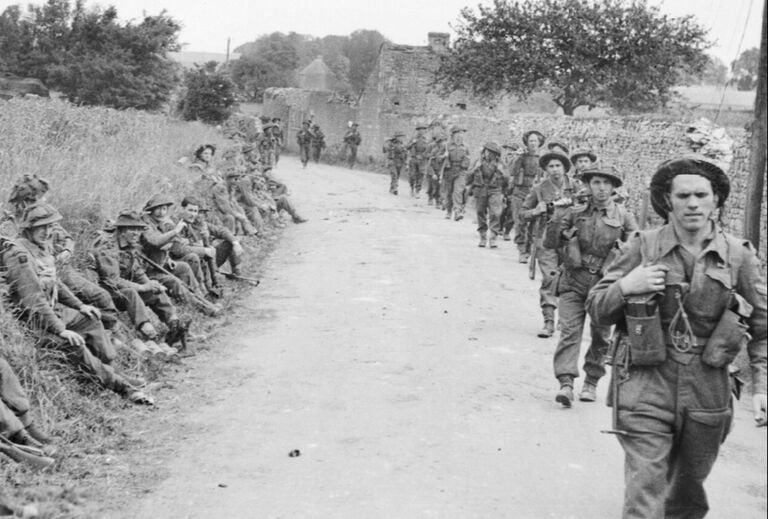
The sea of troops you see below was a sight to behold. You’re looking at the 50th Division of the Infantry from Britain, and they’d reached Gold Beach. From there, they traveled to Crepon, forcing the German soldiers to go south.
On the March
Foxhole Snoozing
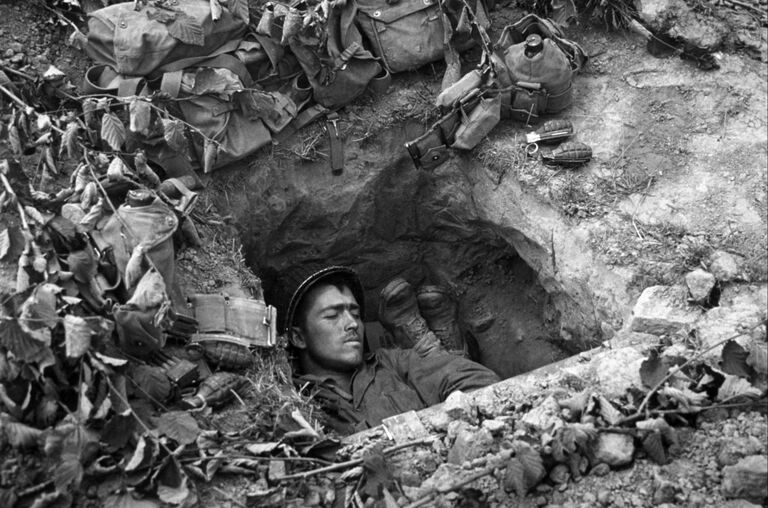
You see a soldier getting some sleep in his foxhole next. It’s hard to determine if those were his boots or that of his comrades. However, the two kits nearby indicate that two men shared the space. They were still ready to fight, as shown by the hand grenades beside them.
Foxhole Snoozing
Juno Beach Arrivals
While the water was shallow, the Canadian soldiers wished they’d been crossing the sand dunes on Juno Beach. This was one of five landing locations on D-Day. In the background, you can see Bernieres-Sur-Mer, and the men had no weapons drawn.
Juno Beach Arrivals
Danger
The photo below is one of the most popular D-Day landing pictures, and it was taken by Robert F. Sargent. He titled it “Death’s Jaws,” which is fitting. Clearly, you can see US Army soldiers of the First Infantry Division moving behind this Omaha Beach ship.
Danger
Rommel’s Asparagus
Erwin Rommel had been assigned to the Atlantic Wall because he was a field marshal of the German military and highly praised. Those poles along the beach were nicknamed “Rommel’s Asparagus” because of their appearance.
Rommel’s Asparagus
Before the Storm
The GIs shown below were very quiet and calm when they spoke to the Red Cross volunteer named Mary Jane Cooke. However, they were hoping for a Normandy day excursion, so they weren’t as relaxed as this photo indicates.
Before the Storm
Odd Way to Ride
The British troops shown below didn’t land on Normandy banks and had to carry their bicycles to shore. Hayling Island saw many bike riders. This was a simulated war exercise, but the men fought for real in only a few weeks.
Odd Way to Ride
Axis Prisoners
Look at the huge crowd of Axis prisoners in this photo! It was snapped in 1944 while the Allies were struggling to reach French lands from the beach. Though Axis forces were surrendering, they still took their fair share of prisoners. Roughly 4,000 were taken just on D-Day.
Axis Prisoners
The Omaha Beach Assault
The 16th Infantry Regiment faced heavy opposition from German troops when they landed on Omaha Beach. Many soldiers headed to the cliffs for cover. Roughly 2,400 soldiers were murdered or missing from this location on D-Day.
The Omaha Beach Assault
Downtime
The Allies had to get into France from the Normandy beaches, though they took a small break in Argentan. This city was about 40 miles away, and the soldiers were part of the 80th Infantry Division. That town was taken in August 1944.
Downtime
Omaha Beach’s Appearance on D-Day+1
You see the 2nd Infantry Division of the US Army in this photo. They’re leaving Omaha Beach and passed a German bunker. While it was June 7, one day after D-Day, they were careful about defensive mechanisms that might still work.
Omaha Beach’s Appearance on D-Day+1
B-26 Marauder
You see the B-26 Marauder bomber crew returning from a successful mission in this photo. The smiles are well-deserved. In fact, airplanes were crucial for the invasion. Between April and June 6, 1944, roughly 11,000 Allied planes had 200,000 flights.
B-26 Marauder
Destination Sword Beach
The photo below shows the British ISB commandos just as they’re reaching Sword Beach (France). They had been scheduled to come once Germany was gone, but they had to fight the defenders, overwhelming them and taking the beach.
Destination Sword Beach
Tidying Up
These men were from the 2nd Ranger Battalion. Colonel James E. Rudder commanded 225 troops that were assaulted on Omaha Beach. It took two days to become victorious, but they finally crippled the enemy’s weapons.
Tidying Up
Sherman Tanks
The 741st Tank Battalion of the US Army had those M4 Sherman tanks you see. They were loaded onto a transportation boat to assist during the Normandy invasion. The snorkels you see behind the vehicles helped with flooding and stalemating.
Sherman Tanks
Bill Millin Plays the Bagpipes
Bill Millin was sailing to Sword Beach with the Brigade Commando troops. He never went anywhere without his bagpipes and chose to play them on the journey. While the Germans thought it was crazy, his comrades enjoyed his antics.
Bill Millin Plays the Bagpipes
Seaside Surrender
The Axis party took a hit on Juno Beach during D-Day. There are two commanders in the group, and they were led to the prison camp by a Canadian soldier holding a bayonet. Thankfully, the Allies were successful here!
Seaside Surrender
US Rangers Ready for Battle
The four men shown below were part of the 5th Ranger Battalion on a landing ship to Omaha Beach. Before that, they were in Weymouth, which was a safe zone. Some of the troops were happy to be in the war, but others seemed scared.
US Rangers Ready for Battle
Gold Beach Shore
The 50th Infantry Division (British and Northumbrian commandos) wasted no time once they got on land. Gold Beach was a crucial attack site. Therefore, soldiers greeted German troops with plenty of opposition to set up the Allied base.
Gold Beach Shore
D-Day Paratroopers
Paratroopers were on their way to Normandy to fight on D-Day. The Douglas C-47 was a durable plane, but these men were clearly stressed. Since they were hurling themselves out of the aircraft, it’s understandable for sure!
D-Day Paratroopers
Huge Operation
The photo below shows the vastness of the assault on Normandy. You see ships and landing boats in the water, balloons in the sky, and goods, people, and vehicles on the shore. This chaotic image depicts D-Day on Omaha Beach.
Huge Operation
Americans Welcomed in Cherbourg
The Allies focused on battling Axis soldiers on D-Day. However, they still had to worry about supplies. Therefore, someone had to take Cherbourg’s main port, which the Germans didn’t want to give up. It took eight days, but the Americans did it.
Americans Welcomed in Cherbourg
Operation Tonga
Operation Tonga was a crucial part of World War II. Below, four paratrooper commanders were preparing. The 6th Airborne Division of Britain synchronized watches the day before D-Day. These men landed in hostile areas and were some of the bravest.
Operation Tonga
Saint-Aubin-sur-Mer
Saint-Aubin-sur-Mer was a beautiful beachfront village located on Juno Beach. You see the 48th Royal Marines disembarking from their landing crafts to start the fight. Though they suffered a loss of 50 percent, they overtook the town.
Saint-Aubin-sur-Mer
Trip to France
Who doesn’t want to visit France? You probably read the country guidebook before you do, but these men likely had other things on their minds. Still, they thought it was funny in the 51st Highland Division, which was part of the second Gold Beach wave.
Trip to France
Omaha Beach Next
You can see soldiers rushing across the water to attack Saint-Laurent-sur-Mer on D-Day. These gents waded out, facing enemy fire the entire way. Though they suffered severe casualties, they overpowered the Germans on June 7.
Omaha Beach Next
Caen Kindness
The Allies were focused on Caen’s transportation center because of the inland highways and waterways. Germans were protecting the city, so it took six weeks of fighting before British/Canadian forces were triumphant. An elderly woman then walks among the wreckage.
Caen Kindness
Disembarking for D-Day
The political characters who made D-Day possible included Franklin D. Roosevelt (US President) and Winston Churchill (British leader). They spent years preparing and knew that a European invasion was crucial for victory.
Disembarking for D-Day
The Saint-Lambert-sur-Dive Surrender
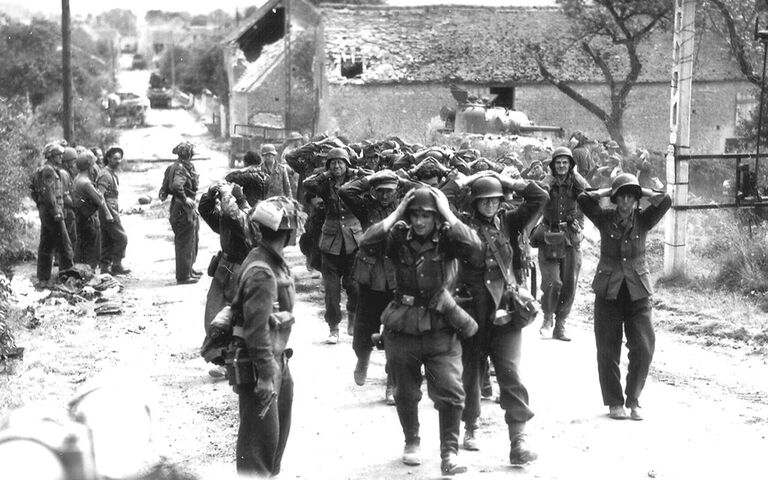
You can see the German troops surrendering on August 21, 1944. About 175 Canadian troops took Saint-Lambert-sur-Dive, which was 35 miles away from the Normandy coast. Those hostages could do nothing more but give up.
The Saint-Lambert-sur-Dive Surrender
Time to Eat
Napoleon Bonaparte and Frederick the Great had their heydays, and many of the battles were fought by soldiers with little in their stomachs. However, the troops on a landing ship decided to grab a meal to keep their strength up.
Time to Eat
The Wreckage of Saint-Aubin-sur-Mer
The 3rd Canadian Infantry Division from the North Shore Regime struggled within the rubble left at Saint-Aubin-sur-Mer. Their unit endured many battles because the city was so fortified. Overall, 124 soldiers lost their lives.
The Wreckage of Saint-Aubin-sur-Mer
Smiling Woman
In this photo, a woman smiles, and it was taken on May 28, 1944, which was a full week before D-Day. Things were quite peaceful, and the English forces returned the smile, looking clean and relaxed because Operation Overload had not occurred yet.
Smiling Woman
Seek Cover on Utah Beach
The 8th Infantry Regiment arrived on D-Day to cover Utah Beach. Men rushed up that pitch because it wasn’t heavily guarded like some of the others. In fact, this troop suffered fewer casualties than others.
Seek Cover on Utah Beach
The Joke
American paratroops fell into the town square of Sainte-Mere-Eglise on June 6. The townspeople seemed happy to have them and even cracked jokes. Who knows which one told it or what it was about!
The Joke
Walking Wounded
These American service members were lucky to be alive, even as they walked among the injured. Most of their friends were killed during D-Day. They were heading to Southampton Port to either go home or find a new fight.
Walking Wounded
A Little Longer
You can see the 18th Infantry Regiment soldiers while they rush to Omaha Beach on a landing ship. The door soon fell on the sand, making them part of the action. Some of the most horrible battles were fought on this beach.
A Little Longer
Woman Entertains
Clearly, these soldiers weren’t part of the battle in France yet. This photo was taken on June 22, 1944, and they were still waiting to fight. Therefore, Mrs. M. Hale decided to play the accordion to make them feel welcome.
Woman Entertains
Gold Beach Landing
The British forces were just arriving for D-Day. This elite squad was called the 47th Royal Navy Commando, and they were on Gold Beach, near Asnelles. The Germans stopped five landing ships, which caused many deaths.
Gold Beach Landing
Buying Cigarettes
You can tell these British soldiers weren’t part of the action in France because they had shiny boots. They stopped in one English town to purchase cigarettes before the fight began. This picture was taken on May 28, 1944.
Buying Cigarettes
Destruction
Check out these soldiers looking at the remains of the German gun site. While it had been part of the defensive system set up at Gold Beach, it was no longer in service. The British troops demolished it all, using three tanks for the job.
Destruction